The Architecture of the Light: On Prince Hall and the Quarry of American Justice
“`
Editorial Essay • Prince Hall Freemasons History
The Architecture of the Light: Inspired by Prince Hall Masons
A reflection on Prince Hall, African Lodge No. 459, brotherhood, civic dignity, service, and the light that continues to guide Prince Hall Freemasonry.
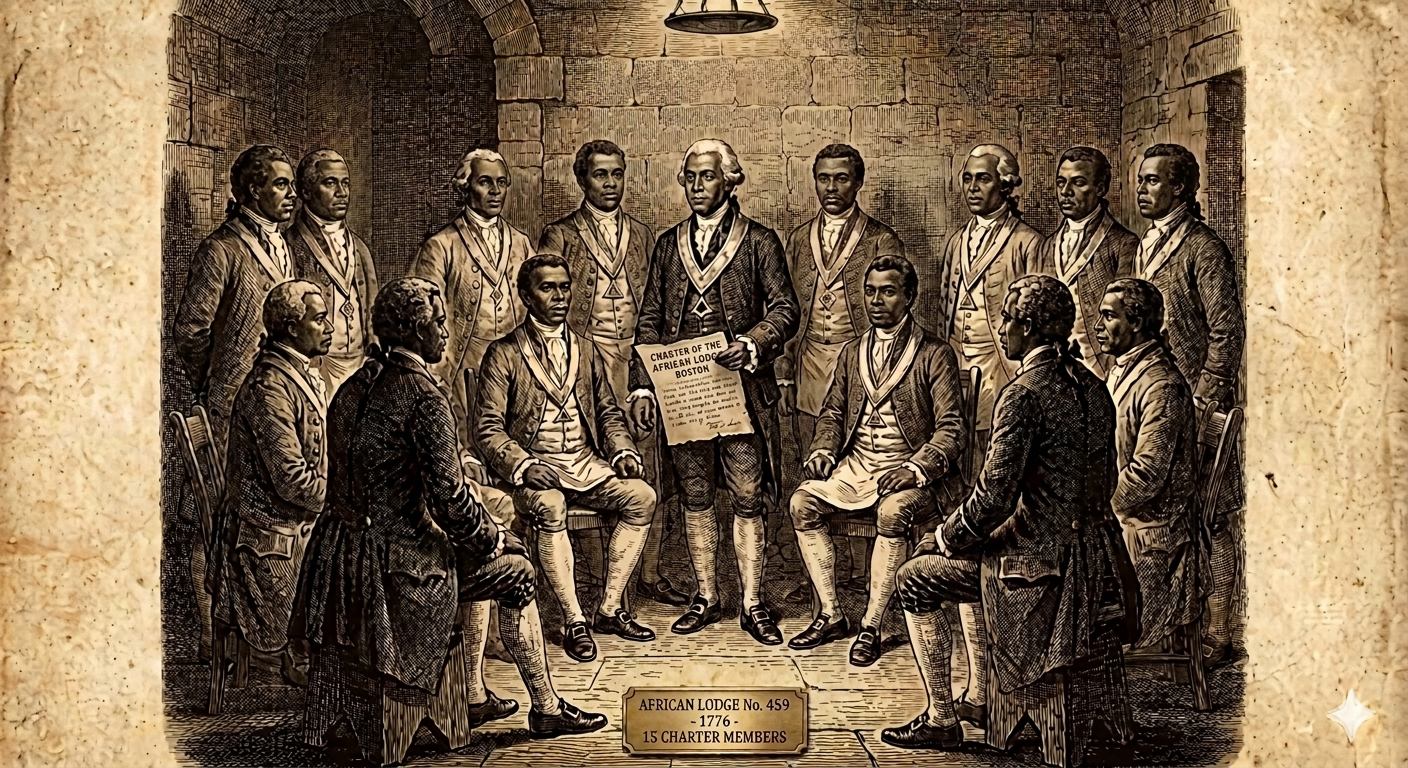
Hero image: Historically inspired editorial illustration of Prince Hall and the founding brothers of African Lodge. This is an artistic reconstruction, not an authenticated historical photograph or portrait.
Editorial note: This inaugural essay is written as public historical reflection. It celebrates the enduring legacy of Prince Hall Masons while respecting the authority of Grand Lodges, the privacy of the Craft, and the importance of official sources for formal research.
Every great institution begins with a light. Sometimes that light appears in a grand hall. Sometimes it appears in a book, a charter, a prayer, a procession, or a quiet act of courage. And sometimes it appears in the hearts of men who refuse to let the world define the limits of their dignity.
The story of Prince Hall Masons is a story of such light.
It is not merely a story about a lodge. It is not merely a story about dates, charters, processions, or titles. It is a story about men who understood that brotherhood must be more than words. It must be practiced. It must be protected. It must be built.
That is why this first reflection on PrinceHallFreemasons.org begins not with darkness, but with light. Darkness is part of the history, but it is not the master of the history. Exclusion was real. Prejudice was real. The barriers were real. But so was courage. So was discipline. So was faith. So was the determination of Prince Hall and his brothers to build something lasting.
Their work became an architecture of the light.
A Light Claimed in 1775
In March of 1775, Prince Hall and fourteen other free Black men stepped into a moment that would echo across generations. They were initiated into Freemasonry by Sergeant John Batt and the Irish soldiers attached to Military Lodge No. 441 of the 38th Regiment of Foot of the British Army.
That moment was extraordinary. These men lived in a society that often denied the full humanity of Black people. Yet they stepped into a tradition that spoke of moral improvement, brotherhood, charity, truth, and the dignity of man. In that act, they claimed a place in a moral universe larger than the prejudice surrounding them.
They were not asking to become men. They were already men.
They were not asking to be given dignity. They already possessed it.
They were claiming the right to organize, to learn, to serve, to build, and to walk uprightly before God and man.
The historical setting matters. The initiation did not take place in a society prepared to welcome them as equals. It took place in colonial America, on the edge of revolution, while the language of liberty was rising in the air even as Black people were still denied its full promise. Prince Hall and his brothers understood the contradiction. They also understood something deeper: light must be claimed, guarded, and carried forward.
The Fifteen Founding Brothers
Prince Hall did not walk alone. He stood with fourteen brothers whose names deserve to be remembered. Their collective step into Freemasonry was not simply a private ceremony. It was a public seed planted for generations yet unborn.
- Cyrus Johnston
- Bueston Slinger
- Prince Rees
- John Canton
- Peter Freeman
- Benjamin Tiler
- Duff Ruform
- Thomas Santerson
- Prince Rayden
- Cato Speain
- Boston Smith
- Peter Best
- Forten Horward, also rendered Forteen Howard
- Richard Titley
These names should not be treated as footnotes. They represent builders. They represent witnesses. They represent men who helped lay the first stones in a structure that would become one of the most important historically Black fraternal traditions in America.
When we speak their names, we are not simply remembering the past. We are acknowledging the foundation.
The Warrant and the Work
After the British military lodge departed Boston, Prince Hall and his brethren continued seeking proper authority to work as a lodge. Their path eventually led to the Grand Lodge of England, which issued a charter to African Lodge No. 459 in 1784. The warrant arrived in Boston in 1787.
The Charter of Lineage
- 1775Prince Hall and fourteen free Black men are initiated at Castle William in Boston Harbor.
- 1784The Grand Lodge of England grants a charter to African Lodge No. 459.
- 1787The warrant for African Lodge No. 459 arrives in Boston.
- 1791African Grand Lodge develops under Prince Hall’s leadership.
Lineage note: Prince Hall Freemasons institutions trace their historical origin through African Lodge No. 459. Formal research should rely on official Grand Lodge sources and primary historical records.
That warrant represented more than permission. It represented continuity. It represented legitimacy in a world that too often denied Black institutions the right to exist on their own terms.
But a warrant alone does not build a legacy. Men build legacy. Work builds legacy. Service builds legacy. Education builds legacy. Character builds legacy.
That is what Prince Hall Masons did.
The Lodge as a School of Light
For Prince Hall Masons, the lodge was never merely a room. It was a school of moral formation, leadership, mutual aid, discipline, dignity, and service.
In a society where Black life was often threatened, restricted, or dismissed, the lodge created a space where men could address one another as Brothers. It was a space where responsibility mattered, learning mattered, charity mattered, and leadership mattered.
The Lodge Room Door
A threshold of dignity. A place where men entered not to escape the world, but to prepare themselves to serve it with greater wisdom, courage, and discipline.
The recognition that no man builds alone and no community rises without mutual obligation.
The commitment to study, memory, history, moral instruction, and self-improvement.
The duty to carry light beyond the lodge room and into families, neighborhoods, institutions, and civic life.
Prince Hall himself modeled that public responsibility. He advocated for the abolition of slavery, education for Black children, relief for widows and families, and the civic dignity of Black people in a nation still struggling to understand its own declarations of liberty.
This is why the legacy of Prince Hall Freemasonry cannot be reduced to symbols alone. Symbols matter, but symbols are not the end of the work. The square must shape conduct. The compasses must measure responsibility. The light must become service.
The Architecture of the Light
Architecture is not only stone, brick, and timber. Architecture is order. It is design. It is the decision to build something that can stand beyond the life of the builder.
Prince Hall Masons built an architecture of the light through institutions, relationships, education, mutual aid, leadership, business, community service, and historical memory.
They built when others doubted them.
They built when doors were closed.
They built when recognition was withheld.
They built because the work was bigger than the approval of the age.
“The light of Prince Hall Freemasonry is not only remembered in history. It is carried forward in service, brotherhood, education, and the work of building better men and stronger communities.”
The Prince Hall Freemasons Directory
That is the spirit this website must honor.
PrinceHallFreemasons.org is being built as an independent public directory and educational resource. Its purpose is not to replace Grand Lodges, speak for jurisdictions, or determine Masonic recognition. Its purpose is to help organize public information, preserve history, connect communities, support member-owned and community-serving businesses, and guide visitors toward proper official sources.
Why the Directory Matters
Public information about Prince Hall Freemasonry is often scattered across state websites, lodge pages, social media, historical archives, old documents, and local memory. Some information is easy to find. Some is outdated. Some is incomplete. Some is at risk of disappearing.
The Prince Hall Freemasons Directory exists to help make the public landscape easier to navigate.
A visitor may be trying to find a Grand Lodge. A family member may be researching a grandfather’s lodge. A young man may be trying to understand how to begin properly. A lodge may want its public information corrected. A researcher may be looking for historical context. A business owner may want to serve the community. A sponsor may want to support preservation and education.
Each of those needs deserves a respectful starting point.
The Directory Mission
What the Directory Does
- Organizes public information
- Preserves historical context
- Connects visitors with official sources
- Supports responsible business visibility
- Encourages education, service, and public understanding
What the Directory Does Not Do
- Does not act as a Grand Lodge
- Does not determine Masonic recognition
- Does not publish private or tyled information
- Does not sell legitimacy or endorsement
- Does not replace official jurisdictional authority
Directory principle: Official sources first. Accuracy before speed. Trust never for sale.
The Work Continues
The story of Prince Hall Masons is not locked in the eighteenth century. It lives wherever Brothers continue the work of self-improvement, relief, truth, education, leadership, and service.
It lives in lodge rooms.
It lives in scholarship programs.
It lives in public service.
It lives in the preservation of records, photographs, names, places, and stories.
It lives in every effort to build something honorable for the next generation.
That is why this first post begins with light. The light is not sentimental. It is not decorative. It is a responsibility.
Prince Hall and his brothers did not simply receive light. They carried it. They organized it. They protected it. They gave it structure. They turned it into an institution.
Now the responsibility belongs to us.
In the Light of the East
To every Brother, researcher, family member, business owner, community partner, and visitor who arrives here: welcome.
This site is being built with respect for history, reverence for the work, and humility before the authority of proper Masonic jurisdictions. It is not the final word. It is a doorway. It is a public guide. It is a place to begin.
The architecture of the light is still being built.
Every accurate record is a stone.
Every preserved history is a stone.
Every corrected listing is a stone.
Every member-owned business supported is a stone.
Every young person educated is a stone.
Every lodge story saved from being forgotten is a stone.
And if we build carefully, honestly, and together, the structure will stand.
The work continues. The lights are burning. Let us walk uprightly, then, in our several stations before God and man, remembering that the greatest monuments are not always made of marble. Some are made of memory, service, brotherhood, and light.
Explore the Prince Hall Freemasons Directory
Continue learning about Prince Hall Freemasonry, African Lodge No. 459, Grand Lodge history, local lodges, public resources, and the living legacy of brotherhood, service, and light.
Independence notice: PrinceHallFreemasons.org is an independent public directory and educational resource. It is not a Grand Lodge, subordinate lodge, national governing body, or official representative of Prince Hall Freemasonry. Official membership, recognition, governance, and jurisdictional questions should be directed to the appropriate Grand Lodge.
“`